Walking onto the special events pier, I hear to my right considerable twittering, recognizable to me as coming from barn swallows. Having not heard that volume of that sort of sound for some weeks, I wonder what to expect. Looking in that direction, I observe a swirl of swallows, about eight in number, just off the side of the pier, over the river. I am intrigued by their aerial acrobatics as they flit and dart in intricate interactions. With fascination I watch the gyre of rapid ascents, swift descents, and quick circles spin partially over the pier, then back over the water. As I ease closer, the cloud of swallows dissipates, along with the nimbus of birdsong.
(I surmise that the group comprises a few adults and several pestering young, clamoring to be fed. Earlier in the season, similar behavior led to the death of an adult swallow, I believe, when the harried bird flew into a chain-link fence. Arriving in the morning, I found the swallow about a foot away from the base of the fence. Making a cursory examination, I found no obvious injuries, other than what appeared to be a broken neck. I speculate that, even possessing the agility and maneuverability for which swallows are renowned, the adult, beset as it was, made a fatal misjudgment causing it to strike the fence.)
After ambling down the pier searching for any other interesting sightings, I return minutes later to again hear swallow twittering, but by fewer birds. Peering over the railing, I spot five barn swallow in a row sitting on a well-weathered beam. The beam is so storm blasted that the upper surface has been reduced to a narrow strip of wood, a nearly perfect perch for swallows with their small, weak feet. The very pale cinnamon and buff of their throats and breasts and the loose downy feathers mark this year’s second group as recently fledged.
The five remain quiet and still, with a minimum of fidgeting, until a bird, any bird, flies within two yards of them. Then the “Feed me, I’m starving to death” routine begins. A noisy clamor erupts, accompanied by frantic fluttering, and widely gaping maws. When the approaching bird is an adult swallow, the display intensifies, until one of the young receives an insect morsel, and then it stops as quickly as it had started.
At one point, an adult deposits an especially large insect in the mouth of one youngster, who grasps the insect in its bill for several seconds, as it is maneuvered into position to be swallowed. For that brief instant, the insect’s sun-glazed antennae, legs, and wings, all projecting in different directions, endow the swallow with a brilliant, bristly moustache. Later, three adults bearing food caught on the wing make deliveries within the space of nanoseconds to three of the young. As I leave the pier, I ponder how the three adults might be related to each other and the the youngsters. Is one a helper from an earlier brood this summer, or from last year? Or is it an example of communal feeding, any adult feeding any fledgling, related or not?
About an hour and a half later, I return once more for the last observations of the morning. A single young swallow is perched on the same beam as before and occasionally an adult alights briefly, perhaps to rest between feeding flights. Four other young stand on a second beam that retains a broad, flat surface. When one or another attempts to walk, it lists to the right or left, nearly toppling over, stretching out a wing to regain its balance. A demonstration of just how really weak their feet are; fine for gripping thin objects, like wires or branches, but inadequate for walking on even planes.
Suddenly all the swallows, adult amd young, take flight in a jumbled mass, and then alight some distance away on a combination of beams, wires, and twigs. Brfore I leave the pier, I take a quick count and come up with a total of ten swallows, mostly young, but with maybe a sprinkling of adults, all too far away for clear differentiation. A productive summer for the barn swallows.
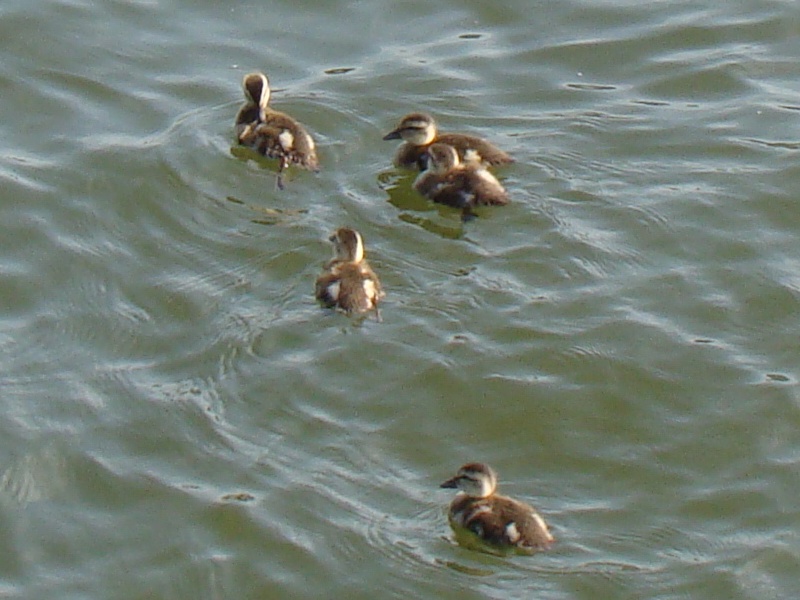
The four mallard ducklings, appearing and disappearing amid the forest of pilings, forage their way toward the river wall moving eastward. The four remaining goslings, nearly the size of their parents, feed on the algae found on the pilings parallel to the river wall, swimming southward. Eventually, at the place where the two sets of pilings converge, the two sets of offspring come together. When the ducks intermingle with the geese, the goslings make several passes at the much smaller ducklings in attempts to attack them. But, as a result of being in fairly open water, not hemmed in by goslings, and proficient swimmers, the ducklings avoid all the assaults, escaping without a blow striking home. As the goslings return to feeding, the mallard hen leads her brood away to safer waters.
After about two minutes, the mallard hen comes speeding back along the route she just traversed, quacking loudly. She stops abruptly when she locates before her the reason for the urgency: a single duckling left behind among the pilings and the geese. Upon seeing the duckling, the hen turns, rapidly retracing her path, trailed by the rescued duckling. The two then climb out of the river onto a flat concrete slab under the pier, where the hen had deposited her three other youngsters. They shake off the river water and the duckling drops down beside its mates to rest, while mama stands and watches over them.
But until they arrive, here is something a little different.
Once upon a time, a double-crested cormorant broke the surface of the river from below holding in its bill a black and silver ovate object glistening in the sunlight. After grappling with it for a few moments, while floating on the water, the cormorant dove, carrying the object with it. Soon the cormorant reemerged grasping the fish, identifiable as a species of flatfish, by its head. The cormorant stretched its neck up, lifting and aligning its head with its neck to create a tube down which to swallow the fish. However, a flatfish is, ah, flat, and a throat is cylindrical, and even a snake with an expandable neck has limits as to what it is able to ingest. Can you image a rattlesnake swallowing a Ping-Pong paddle? So try as it might, the cormorant could not get the fish down. It dove a second time, rearranging the fish, and made another attempt to swallow it, but to no avail.
As the cormorant surfaced from yet another dive and raised the fish into the air once more, a gull, with its eye on said fish, swooped down and narrowly missed seizing it, as the cormorant executed an emergency dive. The gull then landed in the river, where it floated, continually turning its head to scan the surface for the soon to reappear cormorant with its shiny prize. Some yards away, the cormorant and fish arrived at the surface, to be met immediately by the vigilant gull. Another crash dive. Another close call. With two failed tries the gull gave up, flying off to search for an easier meal to steal. The cormorant, retaining its hold on the fish, returned to the surface, made another valiant but futile attempt to swallow its catch, lowered its head to the water, and released the fish. After dipping its face in the river several times, the cormorant turned, swam, …and dove.
The moral of the story:
A roundfish in the belly is worth two in the bill?
The cloudless morning sky, bleached pale blue by a brilliant sun, becomes a hazy blue-gray at the horizon, where New Jersey divides it from the royal blue Hudson River. A southerly breeze, wafting a hint of sea scent, acts as an antidote to the early heat of the day, cooling my skin and freshening my spirits. Wavelets rolling toward the shore break against the decrepit supports of the pier, from which I make my observations, slapping the wooden beams and braces.
As I turn to leave, my eye catches an oddly shaped cluster of floating objects, fuzzy, actually downy, floating objects. Five mallard ducklings cruise behind, along side, and around a mallard hen, as they parallel the pier, traveling toward deeper water. Their course carries them amid a few Canada geese that seem to ignore their passage completely. Their route takes them in the direction of an inactive crane-carrying barge moored at the end of the pier.
In the lee of the barge, the mallard hen stops swimming and immerses herself in the olive colored water. Her action immediately triggers a confused clutter of duckling dipping, with a maximum amount of sloshing and splashing and shaking and spraying. After several minutes, the hen swims toward the pier leading her brood, undeterred by my presence at the railing directly above the area she is heading for.
At intervals along the pier, timbers slant into the river at angles of about 30 degrees, creating ideal locations for ducklings to haul themselves out of the water to dry off, preen, and rest. The hen waddles up the right strut of a pair, followed by her offspring, but halts not leaving enough space for all five ducklings to attain a dry spot. The last in line scoots over to the left strut, running well up it, before beginning to preen. As the other four start smoothing their feathers, a wavelet washes over the lower end of the strut, carrying off one duckling, which frantically swims back to clamber out of the water. With so much energetic stretching and shaking the ducklings jostle one another, causing yet another to plop in to the river, where it then paddles madly back to the strut to scramble back up. At this point, the hen transfers to the left strut, allowing the four remaining ducklings to move farther up the right one, away from the river.
During all this activity, as its mate floats close by, a Canada goose ever so gradually drifts closer to the group, appearing to concentrate its gaze on the ducklings. About two feet from them, the goose abruptly turns to listlessly nibble at some algae on a nearby pier support, before slowly swimming away, joined by its mate. Some time later, when both geese return, one inclines toward the left strut occupied by the hen and one duckling, staying approximately two feet from them, its mate (the male?) toward the other strut accommodating the four remaining ducklings. Steadily, the second goose drifts nearer the quartet, until alarmed they react, two scampering up the strut and two bolting for the other strut. Seemingly startled by the commotion, the goose draws its head and neck back and actually back peddles from the pier. Meeting its mate, it turns and together they swim away.
[I offer the following thoughts on the previous encounter as conjecture.
First, both geese advanced toward the ducklings slowly and quietly, necks erect and heads held high. They exhibited not a single sign of aggressive behavior: no intimidating tactics, no head bobbing, no neck stretching, no hissing, no honking, no spread wings, and no rapid assault, just calming, reassuring movements. All during the approach the gazes of the geese remained fixed steadily on the ducklings.
Second, to my knowledge, as of the moment, of the sixteen, or so, pairs of local geese, three bred successfully, producing broods. Of those, only one brood of four has survived to near adulthood. Perhaps the goose couple was not able to nest, or their nest was destroyed, or the eggs were not viable, or the goslings succumbed to predators or accidents.
Now I tread perilously close to the edge of anthropomorphism with what I say next. To me, the comportment of the geese suggested a wistfulness, a longing for lost goslings, or a failed nest, or a yearning due to a failure to breed at all.]
With the departure of the geese, all six ducks resume preening, when once again a wavelet breaks over the left strut taking a duckling with it as it recedes. That duckling swims to the right strut, and in an effort to escape further dunkings, runs up the strut until it encounters two resting broodmates. Attempting to go farther up the strut, the duckling at first pushes against the pair and, when they fail to move, it tries climbing over them. When the first duckling stepped on squirms beneath its webbed foot, the climber is thrown off balance, causing another fall into the river. As the wet bedraggled creature scrambles up the left strut once more, I reluctantly take my leave of them all, looking for other small adventures.
(A word on ducklings:
This is the third brood of mallard ducklings this year. I observed the first set of six at the beginning of May. However, the hen was so inept that she lost two by the next day, and I never saw another one after that. While the ducklings swam in circles below her, emitting pathetic distress cries, the hen would call to them and hop from one vertical pier support to another. She did not get it into her brain that because the ducklings were unable to fly to her, she had to drop into the river for her presence to comfort them.
I saw the second brood in early June. The hen and four ducklings were resting on the beach, during one of those 90-degree days we experienced. At first, they were in the shade, but as the sun shifted the ducklings became exposed to its full strength. Rather than move her offspring, the hen half raised her right leg, and resting her open right wing on it, created a sun shade for the ducklings.)
A pleasantly warm, sunny morning, with a light northwest breeze, finds the two young goslings already actively foraging at the rocky end of the beach. At the sandy end, the four older goslings, their parents, and the attendant pair are all grooming. After some time, the family of four takes to the water, outside the exposed pilings, swimming along the beach toward the sandy part, just as another pair of geese approaches that area of the beach. Without hesitation, the young goslings’ father lifts off from the water, honking, to fly directly at the male of the pair of perceived transgressors. The intimidated male retreats, so the father then flies at the female, driving her off to follow her mate.
The young goslings and the female join the waiting male and they turn in the direction of the sandy section of the beach, the male in the lead. Nearing the beach, the male lowers his head, stretches his neck, opens his wings to their full extent, and seems to run across the water as he charges the male of the attendant pair at the edge of the river. Reacting immediately, the molting and therefore flightless male hastely withdraws in the face of the very flight-worthy assailant in the only direction possible, into the midst of the also flightless family of six. Whether only tolerated, or even accepted, when on the periphery, the male is not at all welcome when storming into the family group, sending the older goslings scurrying.
The goslings’ father’s reaction is to assail the inadvertent trespasser, seizing it by the wing with its bill, and frog-marching it out of the family’s territory, back the way it entered. However, that route takes them both directly among the family with the young goslings that is just about to come ashore. The male of that group enters the fray by leaping at the conjoined geese as they pass, wildly beating its wings and biting. Its mate, distressed by the tumult, abandons her offspring to become part of the general melee, also flapping and biting. The splashing, thrashing mass of mad geese somehow propels itself across the water until it is disappears from view under the pier. A few honks echo from beneath the pier, then all falls quiet.
Minutes later the female emerges, returning to gather the drifting goslings, after which she floats beside the pier calling to her mate. Soon, he exits the maze of piles and timbers beneath the pier to meet up with his family. Together they swim to the sand beach and leave the water. Eventually, the male from the family of older goslings returns to his mate and offspring. However, the male that was beset by the three geese fails to reappear, his mate standing at the water’s edge waiting, waiting.
Part 2
The older goslings now sprawl on the beach, resting. The two younger goslings begin feeding, moving slowly, steadily inward from the river. As they near the older gosling group, their parents run interference, inserting themselves between their goslings and the other family, giving warnings as they do so. As the other (flightless) parents respond with mild threats, the older goslings pick themselves up in unison and scramble a few feet away before dropping back onto the sand. The younger goslings eat some, then move further along, with their parents positioned between the two groups. Once more the older goslings rise, scoot away, and drop down, without their parents intervening. The foraging youngsters continue along the beach, causing the other goslings to get up and move one last time. For then the young goslings commence to eat their way back whence they had come. It possibly goes to show that in the land of the flightless, the flyer is king, even if outnumbered.
***Comments on blog postings and anything and everything else on these pages are welcome and greatly encouraged, so please feel free to respond, positively or negatively, to the content, textual and visual; suggest corrections or elaborations; ask questions; or propose answers to queries. Thanks.***
Posted at: 04:37 PM | 0 Comments | Add Comment | Permalink
Sharing the Waters
June 8, 2008
On a cool morning of abundant sunshine and moderate northwest wind, walking past the riprap on the southern side of the pier at low tide, I spot, spaced out in the shallow water, several Canada geese and, further along, a few brants, smaller sea geese. Four of the Canada geese are six-week-old goslings, two are their parents, and two are another pair of adults; the brants are five in number. Every one of the geese, adults and young, both species, all thirteen, are engaged in morning ablutions. At any one time, some are nearly totally immersed, others are erect with wings spread, still others are shaking river water from their bodies, and the remaining ones are preening and smoothing feathers. Swimming, dipping, dunking, splashing, rising, flapping, grooming repeated over and again, by each goose and every goose, until the Canada geese clamber on to the rocks to bask, to rest and dry, and the brants gather just off the shore to float, to rest.
Sharing the Waters (But Not Too Much)
Returning later, I see that all the geese remain where I saw them earlier. As I watch, the family of six geese becomes restless, one by one rising, shaking itself, and wiggling its tail, before heading toward the water. Noting that the other pair without offspring has stayed near the family for some time, I observe them more closely, realizing that they have both entered the molting stage. For the parents, the molting process began approximately two weeks before.
(Adult Canada geese, like most waterfowl, undergo a complete molt, replacing frayed, or lost, feathers every year. Molting takes approximately 30 to 35 days between June and August, with all the flight feathers lost simultaneously, rendering the adults as flightless as their young.)
Day length, which effects hormone levels, is the proximal cue for molt initiation, but since two other pairs of geese, one with two-week-old goslings and one with none, have not yet begun to molt, I suspect that some factor, other than day length, is influencing the onset of the molt. Because the pair has continued to associate amicably with the family, I speculate there is a relationship, perhaps genetic, between the family and the pair, that is inducing the early molt. As the family moves toward the area where the pair recline, I make a silent wager with myself: That goose pair will enter the water after the family has swum by.
When the last family member passes in front of the associated pair, first one arises, then the second. After a shake and tail wag, each of the pair descends the gentle, but rocky, slope to enter the river. They swim directly out into deeper water, turn right, and travel parallel to the pier, until coming abreast of the family, whereupon they take up position as escorts, moving with the family, only farther out from shore.
Slowly the family’s six goose flotilla makes its way toward the end of the pier where the brants still float. At the approach of the Canada geese, the brants form a tight cluster and issue threats, lowering their heads, stretching their necks, opening their mouths, and possibly hissing, appearing from shore like some five-headed hydra.. The Canada geese, larger in size and greater in number, persist, closing the distance between the goose groups. Reluctantly, the brants turn, giving up space, only to turn back, delivering more warnings. Relentlessly, the Canada geese proceed on their course; the brants unwillingly give way, offering more challenges. Then, behind the brants, the two escorting geese materialize. Now, confronted by eight Canada geese, the brants grudgingly drift to deeper water, allowing the other geese transit between themselves and the pier, but not before presenting one last threat display. Immediately following the passage of the Canada geese, the brants reclaim their space on the river.
Proceeding north on the walkway, toward the cove, just as a light shower is ending, I turn a corner, coming knee to face with a pair of Canada geese, accompanying two goslings, that are intermittently scurrying along the paved path beside the roses and meandering back and forth across it to sample the vegetation. As I slowly walk backward, so as not to crowd the family and frighten the goslings and/or upset the parents, I contemplate how easy it seems to lose a gosling. Are they really down to two remaining goslings, after starting out with five?
Just then, a man (a marine fireman from the fireboat usually stationed beside the pier?) comes up behind me holding his jacket balled up in his arms. He stoops down, opens the jacket, and the third gosling leaps to the ground, scooting toward his parents and siblings. In answer to my question about where he caught the gosling, he tells me he found it on the other side of the rose bushes, running, running in the wrong direction. When I respond positively to his inquiry if I will watch them, he trots off back to work.
As the geese amble back to the cove, I trail after them, keeping an eye on the wandering gosling threesome. One becomes separated from all the others, just as a man turns the corner, suddenly almost finding himself between two agitated adult geese and a straying gosling. The man stops, takes a few steps back, letting the parents, along with the other goslings, get closer to the wanderer, circles the group, and continues on his way, thus avoiding a confrontation.
The five geese browse on the weedy vegetation growing along the fence and wall dividing the river from the walkway, moving casually toward a gap in the barrier that will allow them access to the riprap at the water’s edge. Occasionally, a gosling goes astray, emits a distress call, prompting honks from the male, and then rejoins the family. Eventually they all reach the opening to the river, amble through, and continue feeding on the other side of the fence in a safer (one hopes) environment than the one they left behind, with its closer proximity to vehicles of all sorts, to people, and to dogs at close quarters.
In a light rain, on the rocky end of the beach, at the water edge, the oldest goslings, along with their parents, feed on the algae found on the old pilings. To the right, the youngest goslings feed among the rocks on the shore, watched over by their parents. One of the little goslings, while searching for delectable morsels, strays to close to the group of older goslings. Too late its father issues warning honks; the small creature is in the midst of the much larger offspring. Three of the older goslings catch the younger one in the water, surrounding it, and biting at its neck, as its agitated parents engage in threat displays directed at the other family group. The gosling struggling in the water makes a difficult target for the bigger goslings, so their attacks and their mother’s occasional bite do no serious damage, and its manages to scramble up between two rocks to hunker down. Fatigued by the assaults the small creature lies still, the assailants lose interest, and then they swim away. As its father continues to summon it with honks, the gosling rouses itself, and labors over the rocks in its path, as it endeavors to reach its family.
At the very same time, the behavior of the four safe goslings becomes decidedly peculiar. Each of the cute, cuddly, bundles of fluff that often pile up together to snuggle, begins nipping at the others necks in a harmless but wild melee. At one point, as three come together, the first bites at the neck of the second, the seconds bites the third, and the third the first, in imitation of what they must have witnessed minutes before.
The mad parody ends when the victimized gosling, having surmounted an obstacle or two, arrives to reunite with its siblings and parents. Making up for lost time and expended energy, everyone immediately starts gobbling anything within reach that is edible.
At the cove, the female of a pair of Canada geese without offspring swims among the pilings feeding on the algae, while her mate stands above the beach on a small concrete platform just inside the fence separating the walkway from the river environs. Suddenly, the cry of a gosling in distress sounds across the water, as a small yellowish ball of fluff proceeds rapidly over the surface in the direction of the exposed beach. The male honks once, then once again more loudly, and flies off toward the call. He lands at the water’s edge as the gosling, one of the youngest brood, struggles ashore, collapsing just out of reach of the incoming tide. With the gosling falling silent, having attained a perceived safety, the male, standing near, starts in on a thorough preening.
The exhausted gosling sprawls on the beach, its neck drooping and its head falling first left, then right, on to the wet sand. After some minutes, the gosling totters away from the approaching tide to an algae-covered rock, where it begins nibbling. Succumbing to fatigue, the gosling lets its head fall until its bill rests on the rock. Waking, the gosling feeds once more, more energetically. Soon the female goose, still feeding, swims to the pilings closer to the gosling, which springs up, races across the sand, and speedily paddles toward her, only to be attacked by her as it approaches. Swimming away, the gosling takes up nibbling algae on one piling after another.
Meanwhile, among the pilings on the farther side of the pier marking the northern margin of the cove, the gosling’s parents and four siblings are scattered about feeding. At one point, the male begins honking, and first one gosling appears, then his mate, and finally the three remaining goslings. The family moves to the pier itself, foraging among the supports, proceeding along the length of the pier, not swimming under it and traversing its width.
Back on the near side of the pier, even though they both ignore the gosling, it stops feeding to follow the pair of geese toward the riprap of the southern pier, in the direction away from its family. Fortunately, the adult geese turn around and head straight for the northern pier, the gosling trailing behind. The pair enter the area under the pier, followed by the gosling, which almost immediately loses track of them. As the gosling utters his distress call, it is amplified in the low-ceiling space beneath the pier, and is carried to his family on the other side. Hearing the cry, both parents become agitated, pulling back their necks, than thrusting them forward. The male honks loudly, then even louder. The gosling’s call increases in volume, as it frantically swims toward the male’s honking. Suddenly, amid the two adult geese and four goslings a fifth gosling appears and life returns to normal.
Speeding across the water of the cove a line of Canada geese, one adult ahead, five goslings in the middle, one adult behind, swims directly to the beach. Reaching shore they all hustle out of the water up on to the sand, where they begin drying and smoothing their feathers. After a time, the female lowers herself to the ground, whereupon the five youngsters press themselves up against her. She envelops them with her left wing, pulls them close to her body, tucks her bill under her scapulars (shoulder feathers), and they all nap, with three small heads peeking out from between the mother’s wing and body. While resting the female exhibits a behavior known as sleep vigilance, in which, while half her brain sleeps, she briefly, but repeatedly, opens the eye controlled by the waking part of her brain, takes note of her surroundings, and closes the eye again.
Several minutes later, the most exposed gosling attempts to preen in the confined space between wing and body, thereby disturbing its neighbor, whose squirming movements annoy its neighbor. Before long, the female, becoming bothered by the fidgeting, stands up abruptly. First one gosling drops to the ground, followed by a second, then a third falls. When the female takes a step toward the water, the fourth gosling hits the sand, and the fifth finally shakes loose as she takes a second step. The five goslings each pick themselves up, shake themselves off, and run after the female.